Non vivo il mio operare come una competizione,
non ricerco disperatamente un nuovo linguaggio,
anche perché, casomai, arriverà da sé.
La mia è una pittura di meditazione
in connessione con il passato e presente
nel “Qui e ora”.
Alessandro Maio
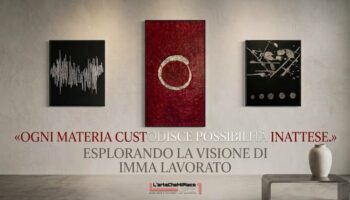
C’è un momento, nell’esperienza artistica, in cui il gesto si sottrae alla funzione di spiegare e assume il compito di interrogare, aspetto più difficile e radicale. Esso non pretende comprensione immediata, ma richiede consenso e partecipazione. Ed è in questa soglia — precaria, instabile, eppure inevitabile — che prende corpo la pittura di Alessandro Maio. Una pittura che non nasce dal desiderio di rappresentare il mondo, ma dall’urgenza di precederlo, di afferrarne l’origine, di coglierne l’energia prima che si dispieghi in forme riconoscibili.
L’artista non parte dal disegno. È un dettaglio che torna spesso, quasi fosse un’anomalia tecnica, e che invece rivela una scelta di campo. Rinunciare al disegno significa sospendere l’idea di progetto, sottrarsi alla rassicurazione dell’anticipazione, accettare che l’opera accada prima ancora di essere pensata. Il colore arriva per primo, come un evento. Il gesto non arriva a coronare un racconto già pensato, ma lo mette in moto. La pittura, qui, non si incarica di restituire una forma compiuta, bensì di intercettare un processo in atto, qualcosa che assomiglia più a un principio, a un’origine ancora instabile, che non a un’immagine definitivamente riconoscibile.


I vortici che attraversano le sue tele, e che troppo facilmente si rischierebbe di ridurre a cifra stilistica, funzionano piuttosto come dispositivi concettuali. Essi generano e rendono percepibile il movimento, trasformando la superficie della tela in un luogo dove spazio e tempo oscillano insieme.
Sono luoghi in cui lo spazio sembra perdere stabilità e il tempo smette di procedere in linea retta. Qui il riferimento al futurismo e al vorticismo non è nostalgico né citazionista, ma strutturale. Come allora, anche nei lavori di Alessandro Maio il problema non è la forma, bensì l’energia che la precede, quel momento indistinto in cui gli elementi non sono ancora separati e tutto è, per usare una sua espressione ricorrente, “informazione”.


Umberto Boccioni, nella sua riflessione sulla pittura futurista, scriveva: “Verrà un tempo in cui il quadro non sarà più sufficiente, la sua immobilità diventerà un arcaismo rispetto al vertiginoso movimento della vita umana. L’occhio dell’uomo percepirà i colori come sensazioni in sé…” È proprio questo principio a prendere forma attraverso il gesto istintivo, la materia cromatica e i vortici che percorrono e animano le sue tele. Non siamo di fronte a forme chiuse, ma a un processo in divenire, un luogo in cui colore e tempo assumono corpo e coscienza.


È in questa zona che prende corpo l’idea di un “ordine implicito”, percepito più come ipotesi e non come sistema rassicurante. Un ordine che non si mostra mai del tutto, che resta velato, attraversato da geometrie trasparenti, da filigrane che dissolvono ogni confine. Le sue velature non fissano mai nulla in modo definitivo, ma alludono, aprendo lo sguardo a ciò che sfugge. In esse, l’effimero diventa visibile, e ciò che crediamo materia si rivela istante di energia vibrante, condensazione temporanea di un flusso che non smette di muoversi.
Il percorso cromatico dell’artista si muove controcorrente, in un tempo in cui le immagini si accavallano e la velocità detta il ritmo dello sguardo. Non ti seduce subito, non ti porge appigli narrativi evidenti, ma ti costringe a fermarti, a respirare insieme all’energia che vibra sotto la superficie, a entrare in uno spazio sospeso dove ogni campitura apre un varco sull’indefinito.

La sua pittura chiede tempo. Chiede silenzio. Chiede, soprattutto, una disponibilità interiore che oggi appare quasi sovversiva. Non è un caso che la sua ricerca si accompagni a una riflessione critica sulla società contemporanea, percepita come un sistema che consuma forme svuotandole di senso, confezionando, per usare un’espressione ricorrente nella critica che lo accompagna, “contenitori di vuoto”.
Eppure, il vuoto, nel lavoro di Alessandro Maio, non è mai mancanza. Nella serie, significativamente intitolata Dal Vuoto, esso diventa origine, matrice, punto di partenza. Dipinto con smalti, con segni incisivi e colori puri, il vuoto si trasforma in pienezza, in spazio generativo. È un ribaltamento che riguarda non solo la pittura, ma una visione del mondo, contro una società che teme il silenzio e riempie ogni interstizio, l’artista rivendica il diritto a un caos primario, a un ritorno a ciò che precede la forma definitiva.


Questa energia indomita tra caos e struttura, tra istinto e consapevolezza, attraversa tutta la sua produzione, anche quando affiora una dimensione più figurativa, legata al mito, alla storia, alla memoria della Sicilia. Ma anche qui, nulla è mai descrittivo. L’isola non è paesaggio, bensì palinsesto, stratificazione di culture, luce e ombra, mito e ferita. Una presenza che si avverte anche quando non si vede, come un sottofondo identitario che alimenta la pittura senza mai imprigionarla in un’immagine riconoscibile.
C’è infine, nella ricerca di Alessandro Maio, una domanda etica che resta aperta e che forse ne costituisce il nucleo più profondo: quale responsabilità ha oggi il gesto individuale? Se ogni azione, come egli stesso afferma, può avere effetti sull’intera umanità, allora anche il primo colore posato su una tela non è mai innocente. La pratica artistica diventa così un atto di consapevolezza, un tentativo, fragile ma necessario, di ristabilire una relazione tra l’individuo e la collettività, tra arte e vita.

Forse è proprio qui che la sua opera trova la sua ragione più autentica, nel non offrire risposte preconfezionate. Dipingere per lui significa perpetuare l’attraversamento dell’origine, seguire una traccia di energia che sfugge a ogni definizione e non si lascia catturare e trasformare in immagine compiuta. Ogni gesto, ogni vortice cromatico, è un invito a sostare nell’indeterminatezza, a percepire l’atto creativo come un processo in costante divenire.
E resta da chiedersi se, oggi, non sia proprio questa capacità di sospendere il compimento la forma più radicale e necessaria di contemporaneità.
© Giuseppina Irene Groccia, 2026. Tutti i diritti riservati.

ALESSANDRO MAIO
Maio si avvicina al mondo della pittura da autodidatta. Interessante è l’incontro con il Maestro Italo-inglese John Picking, da cui apprende le tecniche dell’olio e dell’incisione, propedeutiche per lo sviluppo autonomo e indipendente che connota il suo percorso. Desideroso di suscitare emozioni nell’osservatore, l’artista emerge nel variegato panorama contemporaneo tramite la vis cromatica che gli è propria, memore, in ciò, del paesaggio insulare in cui è nato e in cui tuttora vive. Nella maturazione della poetica dell’autore, nomi quali Hieronymus Bosch, Nicolas Poussin, George Grosz, Georges Mathieu e Mario Schifano hanno sicuramente svolto un ruolo non marginale: a questi il pittore si è infatti rivolto con ammirazione. Prendono così vita scenari astratto – informali in cui è il colore (evanescente, incisivo, geometrico) a dare carattere e personalità alle opere, con atmosfere spesso surreali. […] Fil rouge che unisce i cicli della sua produzione è la caducità delle cose materiali. In tal senso, i gesti informali sul mezzo pittorico devono intendersi come moti dei singoli elementi intercettati dal nostro apparato sensistico. Essi rappresentano dunque l’energia che dal vuoto si manifesta in materia tangibile, seppur effimera e soggetta a continui cambiamenti ed evoluzioni. […] Tra le partecipazioni più rappresentative: Triennale di arti visive a Roma, 2014, presso l’università La Sapienza. Premio Sulmona (su invito) 2016, 2020, 2021, 2022, 2023, due volte premiato con menzione speciale di merito. Premio “Pittura e Poesia” Roseto Degli Abruzzi (TE). Vincitore del concorso “Arte Memoria e Legalita” 2021, patrocinato dalla presidenza della Repubblica. Suoi dipinti si trovano in diverse collezioni pubbliche nazionali e in importanti collezioni private
Si sono occupati del suo lavoro
Aldo Albani, Alessandro Celli, Gianluca Covelli, Felicia Lo Cicero, Paolo Giansiracusa, Giorgio di Genova, Paolo Levi, Enzo Le Pera, Ghislain Mayaud Giuseppe Possa, Daniele Radini Tedeschi, Maurizio Vitiello, Vittorio Sgarbi.
Da Atlante dell’arte contemporanea De Agostini.
Scroll down for the English text:
There is a moment, in the artistic experience, when gesture withdraws from the function of explanation and takes on the more difficult and radical task of questioning. It does not seek immediate understanding, but rather demands assent and participation. It is at this threshold—precarious, unstable, yet inevitable—that the painting of Alessandro Maio takes shape. A painting that does not arise from the desire to represent the world, but from the urgency to precede it, to grasp its origin, to seize its energy before it unfolds into recognizable forms.
The artist does not begin with drawing. This is a detail often mentioned, almost as if it were a technical anomaly, yet it reveals a clear position. Renouncing drawing means suspending the idea of a project, relinquishing the reassurance of anticipation, accepting that the work happens even before it is thought. Color comes first, like an event. The gesture does not crown a premeditated narrative; it sets it in motion. Painting here is not tasked with delivering a finished form, but with intercepting a process underway—something closer to a principle, an unstable origin, than to a definitively recognizable image.
The vortices that traverse his canvases, which one might too easily reduce to a stylistic signature, function instead as conceptual devices. They generate and make movement perceptible, transforming the surface of the canvas into a place where space and time oscillate together.
These are sites in which space seems to lose its stability and time ceases to proceed in a linear manner. Here, the reference to Futurism and Vorticism is neither nostalgic nor citational, but structural. As in those movements, the problem in Alessandro Maio’s work is not form, but the energy that precedes it—that indistinct moment in which elements are not yet separated and everything is, to use one of his recurring expressions, “information.”
Umberto Boccioni, in his reflections on Futurist painting, wrote: “A time will come when the picture will no longer be sufficient; its immobility will become an archaism in comparison with the vertiginous movement of human life. The eye of man will perceive colors as sensations in themselves…” It is precisely this principle that takes shape through instinctive gesture, chromatic matter, and the vortices that run through and animate his canvases. We are not faced with closed forms, but with a process in becoming, a place where color and time take on body and consciousness.
It is within this zone that the idea of an “implicit order” emerges—perceived more as a hypothesis than as a reassuring system. An order that never fully reveals itself, remaining veiled, crossed by transparent geometries, by filigrees that dissolve every boundary. His glazes never fix anything definitively; they allude, opening the gaze toward what escapes. In them, the ephemeral becomes visible, and what we believe to be matter reveals itself as an instant of vibrating energy, a temporary condensation of a flow that never ceases to move.
The artist’s chromatic trajectory moves against the current, at a time when images overlap and speed dictates the rhythm of looking. It does not seduce immediately, it offers no obvious narrative footholds, but instead forces us to stop, to breathe alongside the energy vibrating beneath the surface, to enter a suspended space where each field of color opens a passage toward the indefinite.
His painting asks for time. It asks for silence. Above all, it asks for an inner availability that today appears almost subversive. It is no coincidence that his research is accompanied by a critical reflection on contemporary society, perceived as a system that consumes forms by emptying them of meaning, packaging—using a recurring expression in the criticism surrounding his work—“containers of emptiness.”
Yet emptiness, in Alessandro Maio’s work, is never absence. In the series tellingly titled Dal Vuoto (From the Void), it becomes origin, matrix, point of departure. Painted with enamels, incisive marks, and pure colors, the void is transformed into fullness, into generative space. This reversal concerns not only painting, but a worldview: against a society that fears silence and fills every interstice, the artist claims the right to a primordial chaos, to a return to what precedes definitive form.
This untamed energy between chaos and structure, between instinct and awareness, runs through his entire production, even when a more figurative dimension emerges, linked to myth, history, and the memory of Sicily. But here too, nothing is ever descriptive. The island is not landscape, but palimpsest—a stratification of cultures, light and shadow, myth and wound. A presence that is felt even when it is not seen, like an identitarian undertone that nourishes the painting without ever imprisoning it in a recognizable image.
Finally, in Alessandro Maio’s research, there is an ethical question that remains open and perhaps constitutes its deepest core: what responsibility does individual gesture carry today? If every action, as he himself states, can have effects on all of humanity, then even the first color laid on a canvas is never innocent. Artistic practice thus becomes an act of awareness, a fragile yet necessary attempt to reestablish a relationship between the individual and the collective, between art and life.
Perhaps it is precisely here that his work finds its most authentic reason: in refusing to offer ready-made answers. For him, painting means perpetuating the crossing of origin, following a trace of energy that escapes every definition and cannot be captured and transformed into a finished image. Every gesture, every chromatic vortex, is an invitation to linger in indeterminacy, to perceive the creative act as a process in constant becoming.
And one is left to ask whether today this very ability to suspend completion is not the most radical and necessary form of contemporaneity.
© Giuseppina Irene Groccia, 2026. All rights reserved.
ALESSANDRO MAIO
Maio approached the world of painting as a self-taught artist. A significant moment in his formation was his encounter with the Italo-British master John Picking, from whom he learned oil painting and printmaking techniques—foundational skills that supported the autonomous and independent development characterizing his artistic path. Eager to evoke emotions in the viewer, the artist stands out in the diverse contemporary scene through his distinctive chromatic intensity, reflecting the insular landscape of his birthplace, where he continues to live.
In the maturation of his artistic poetics, names such as Hieronymus Bosch, Nicolas Poussin, George Grosz, Georges Mathieu, and Mario Schifano have undoubtedly played a significant role: Maio has engaged with these artists with genuine admiration. From this engagement emerge abstract-informal scenarios in which color—evanescent, incisive, geometric—imparts character and personality to the works, often creating surreal atmospheres. […]
A common thread throughout his body of work is the transience of material things. In this sense, informal gestures on the pictorial surface should be understood as movements of individual elements intercepted by our sensory apparatus. They thus represent the energy that manifests from the void into tangible matter, though ephemeral and subject to constant change and evolution. […]
Among his most notable participations: Triennale of Visual Arts in Rome, 2014, at La Sapienza University; Premio Sulmona (by invitation) 2016, 2020, 2021, 2022, 2023, twice awarded with special merit mentions; “Pittura e Poesia” Prize in Roseto Degli Abruzzi (TE); winner of the “Arte Memoria e Legalità” competition, 2021, sponsored by the Presidency of the Republic. His paintings are part of various national public collections and important private collections.
Critics and scholars who have written about his work:
Aldo Albani, Alessandro Celli, Gianluca Covelli, Felicia Lo Cicero, Paolo Giansiracusa, Giorgio di Genova, Paolo Levi, Enzo Le Pera, Ghislain Mayaud, Giuseppe Possa, Daniele Radini Tedeschi, Maurizio Vitiello, Vittorio Sgarbi.
From Atlante dell’Arte Contemporanea, De Agostini.